Car Engine Blocks: Everything You Need to Know

The car engine block is the structural core of an internal combustion engine. Every major engine component—cylinders, pistons, crankshaft, coolant passages, and oil galleries—either sits inside the block or connects directly to it. Because of this central role, the design and manufacturing quality of the engine block directly influence engine durability, efficiency, and performance.
Whether you are a mechanic, distributor, or automotive parts buyer, understanding the engine block helps you evaluate engine quality, diagnose mechanical issues, and select suitable replacement components. This guide explains what an engine block is, how it works, the materials used to manufacture it, and the key factors to consider when choosing one.

What Is a Car Engine Block?

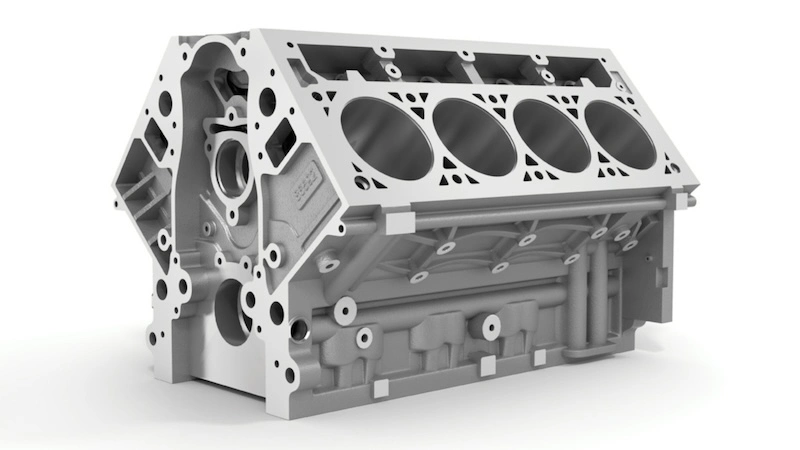
A car engine block, sometimes called the cylinder block, is the main body of the engine that houses the cylinders and supports critical moving parts.
At its most basic level, the block performs three essential functions:
  1. Structural support – It forms the rigid frame that holds the engine together.
  2. Cylinder housing – It contains the cylinders where combustion occurs.
  3. Fluid circulation – It integrates passages for engine oil and coolant.
Because the block must withstand extreme conditions—including combustion pressures exceeding thousands of PSI and temperatures above 200°C—its design and manufacturing precision are critical.

Most modern vehicles use either inline, V-type, or flat (boxer) engine layouts, and the engine block is designed accordingly to accommodate these cylinder configurations.

Main Components Found Inside an Engine Block

Although the block itself appears as a single cast metal structure, it incorporates several integrated components that support engine operation.

Cylinders

The cylinders are precisely machined cavities inside the engine block where pistons move up and down. Combustion takes place here, converting fuel energy into mechanical power.
Each cylinder must maintain tight tolerances and a perfectly smooth surface to reduce friction and ensure proper sealing with piston rings.

Some blocks use replaceable cylinder liners, while others are designed with integrated cylinder bores.

Crankcase
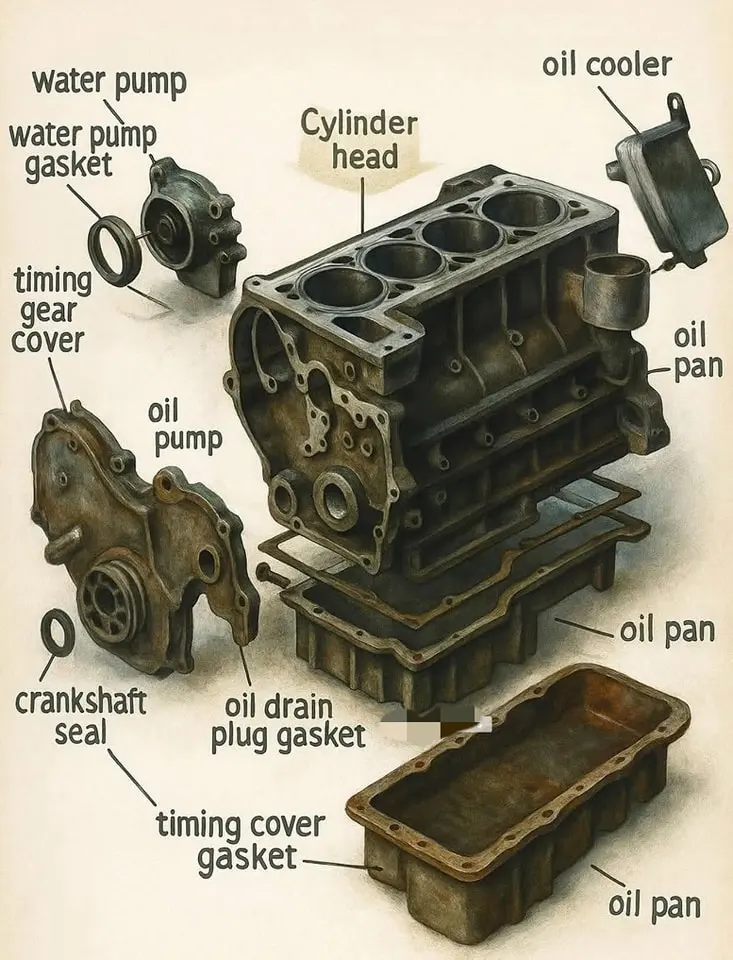
The lower portion of the engine block forms the crankcase, which houses the crankshaft.
This area supports:
  • Crankshaft main bearings
  • Connecting rods
  • Rotating assembly components
The crankcase must be extremely rigid to handle rotational forces generated by the crankshaft during engine operation.

Coolant Passages

Engine blocks contain internal channels called water jackets that allow coolant to circulate around the cylinders.
These passages help:
  • Dissipate heat generated during combustion
  • Maintain stable operating temperatures
  • Prevent engine overheating
Efficient cooling is critical for maintaining consistent engine performance and avoiding structural damage.

Oil Galleries

Oil galleries are internal channels that distribute lubricating oil throughout the engine.
These passages supply oil to:
  • Crankshaft bearings
  • Camshaft bearings
  • Pistons and cylinder walls
Proper lubrication reduces friction, prevents metal wear, and extends engine life.

Deck Surface

The deck is the top surface of the engine block where the cylinder head is mounted.
This surface must be perfectly flat to ensure a proper seal with the head gasket. Even minor warping can cause coolant leaks, compression loss, or engine overheating.

Common Materials Used in Engine Blocks

The material used to manufacture an engine block significantly affects engine weight, durability, heat management, and overall efficiency. Modern automotive engines are typically built from cast iron, aluminum alloys, or in some specialized cases, compacted graphite iron (CGI). Each material offers distinct engineering characteristics that make it suitable for different vehicle applications.

Cast Iron

Cast iron has historically been one of the most widely used engine block materials due to its excellent strength and wear resistance. It performs particularly well under high compression and heavy mechanical loads, which is why it remains common in diesel engines, trucks, and heavy-duty vehicles.
Another advantage of cast iron is its ability to dampen vibration and resist deformation under stress. However, its main drawback is weight. Cast iron blocks are significantly heavier than aluminum ones, which can increase overall vehicle weight and negatively affect fuel efficiency.

Aluminum Alloy

Aluminum alloy has become the preferred material for many modern automotive engines. Compared with cast iron, aluminum is much lighter, which helps reduce vehicle weight and improve fuel economy.
Aluminum also has excellent thermal conductivity, allowing heat to dissipate more efficiently from the combustion chambers. This improved heat management helps maintain stable engine temperatures and can contribute to better long-term performance.

Because aluminum is softer than iron, most aluminum engine blocks use steel or cast-iron cylinder liners to maintain cylinder durability. With modern casting technologies and reinforced block designs, aluminum blocks now offer a strong balance of lightweight performance, cooling efficiency, and sufficient structural strength for most passenger vehicles.

Compacted Graphite Iron (CGI)

Compacted graphite iron is an advanced material used in certain high-performance and modern diesel engines. Its microstructure provides greater fatigue strength than traditional cast iron while maintaining better thermal conductivity.
CGI offers an effective balance between durability and weight, but its manufacturing process is more complex and costly. For this reason, it is generally used in engines that require extremely high strength and durability rather than in typical mass-market passenger vehicles.

The following table summarizes the key differences between these engine block materials:

Material Weight Strength & Durability Heat Dissipation Typical Applications Key Characteristics
Cast Iron
Heavy
Very high strength and wear resistance
Moderate
Diesel engines, trucks, heavy-duty vehicles
Extremely durable and resistant to deformation under heavy loads
Aluminum Alloy
Light
Good strength with reinforced designs
Excellent
Passenger cars, modern gasoline engines, performance vehicles
Lightweight, efficient heat transfer, widely adopted in modern engine design
Compacted Graphite Iron (CGI)
Medium
Higher fatigue strength than cast iron
Better than cast iron
High-performance engines, modern diesel engines
Advanced material combining strength and reduced weight

Types of Engine Block Designs

Engine blocks are also categorized by cylinder structure and cooling design.

Inline Engine Block

Inline engines arrange all cylinders in a single row.
Common examples include inline-4 and inline-6 engines.
Advantages:
  • Simpler design
  • Lower manufacturing cost
  • Easier maintenance
Inline engines are widely used in compact cars and mid-size vehicles.

V-Type Engine Block

In a V-type engine, cylinders are arranged in two angled rows.
Common configurations include:
  • V6 engines
  • V8 engines
Advantages:
  • Shorter engine length
  • Higher power potential
  • Better weight distribution in performance vehicles

V-type engines are commonly found in SUVs, trucks, and high-performance cars.

Flat (Boxer) Engine Block

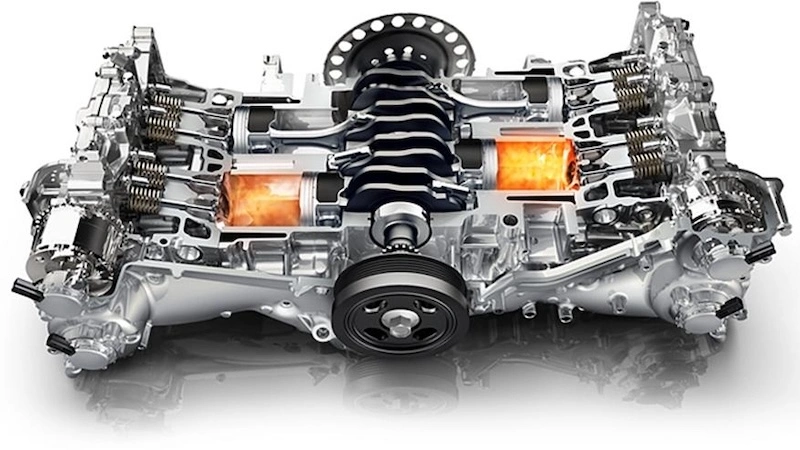
A flat or boxer engine arranges cylinders horizontally on opposite sides of the crankshaft.

This design provides:
  • Lower center of gravity
  • Improved vehicle stability
  • Reduced engine vibration

However, boxer engines are more complex to manufacture and service.
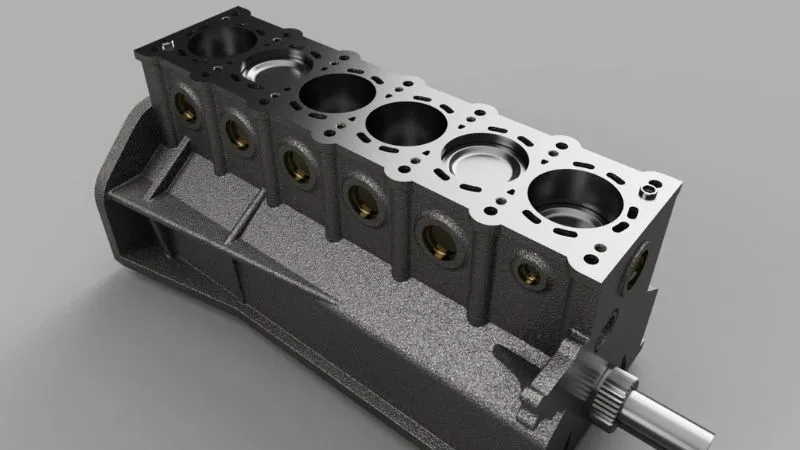
Inline-Engine-Block
Inline Engine Block
V-Type-Engine-Block
V-Type Engine Block
Flat (Boxer) Engine Block

Manufacturing Process of an Engine Block

Producing a high-quality engine block requires several precise manufacturing stages. Each step ensures that the block can withstand high temperatures, combustion pressure, and long-term mechanical stress while maintaining dimensional accuracy and structural integrity.

Metal Casting

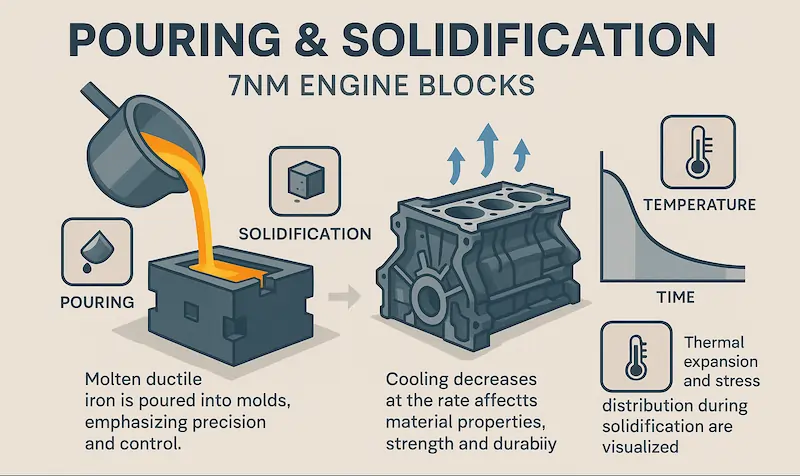
The manufacturing process begins with metal casting, where molten metal is poured into specially designed molds to form the basic shape of the engine block. This casting stage creates the internal structure of the block, including cylinder cavities, coolant passages, and oil galleries. Modern engine block production commonly uses sand casting or precision casting techniques, which allow manufacturers to achieve complex internal geometries while maintaining strong structural integrity. Accurate casting is essential because it determines the initial quality of the block and reduces the amount of machining required later in the production process.

Heat Treatment

After casting, the engine block typically undergoes heat treatment to improve the mechanical properties of the material. Heat treatment strengthens the metal structure and increases its resistance to thermal stress and mechanical fatigue. During engine operation, the block must endure constant temperature fluctuations and high internal pressure from combustion. Proper heat treatment helps stabilize the metal and prevents deformation or cracking over time, ensuring that the engine block maintains its structural reliability under demanding conditions.

CNC Machining

Once the casting has been stabilized through heat treatment, the engine block moves to the precision machining stage. Computer numerical control (CNC) machines are used to finish critical surfaces and bring the block to exact dimensional specifications. This stage includes machining the cylinder bores, milling the deck surface where the cylinder head will be mounted, and shaping the bearing seats that support the crankshaft. High-precision machining is crucial because even small alignment errors can affect piston movement, crankshaft rotation, and overall engine efficiency.

Quality Inspection

Before the engine block leaves the factory, it undergoes a series of rigorous quality inspections to ensure reliability and manufacturing accuracy. These inspections verify that internal coolant passages are sealed correctly, that all critical dimensions meet strict engineering tolerances, and that machined surfaces meet required finish standards. Comprehensive quality control ensures that each engine block can perform reliably under real operating conditions and maintain long-term durability in the vehicle.
Manufacturing-Process-of-an-Engine-Block

Common Engine Block Problems

Even well-designed engine blocks can develop issues over time due to stress, overheating, or manufacturing defects.

Cracked Engine Block

Cracks can occur due to extreme temperature changes, coolant freezing, or excessive engine stress.

Symptoms may include:
  • Coolant loss
  • Oil contamination
  • White exhaust smoke
  • Engine overheating
Severe cracks usually require block replacement.

Warped Deck Surface

Overheating can cause the block’s deck surface to warp, preventing proper sealing with the cylinder head.

Common signs include:
  • Blown head gasket
  • Coolant leaks
  • Reduced compression

Resurfacing may fix minor warping, but severe distortion requires replacement.

Cylinder Wear

Continuous piston movement can gradually wear down cylinder walls.

This may lead to:
  • Increased oil consumption
  • Loss of engine compression
  • Reduced engine performance
Solutions often involve re-boring the cylinders or installing cylinder liners.

How to Choose the Right Car Engine Block

For automotive parts distributors, workshops, and fleet operators, selecting the correct engine block requires evaluating several technical factors.

Compatibility

The engine block must match the specific engine model and configuration. Key parameters include:
  • Engine displacement
  • Cylinder arrangement
  • Bore spacing
  • Mounting points

Even small design differences can prevent proper installation.

Material and Application

Different applications require different materials.

For example:
  • Heavy-duty trucks benefit from cast iron blocks for durability.
  • Passenger vehicles often use aluminum blocks to reduce weight.
Selecting the appropriate material ensures optimal performance and lifespan.

Machining Precision

High-quality machining directly affects engine reliability.

Look for blocks that feature:
  • Precision cylinder honing
  • Accurate bearing alignment
  • Smooth deck surfaces
Poor machining tolerances can lead to premature engine failure.

Manufacturing Quality

Reliable suppliers typically implement strict production and testing standards.

Important indicators include:
  • Advanced casting technology
  • CNC machining processes
  • Comprehensive quality inspections
These factors contribute to consistent product performance.

Why the Engine Block Matters in Overall Engine Performance

Although many drivers focus on components like turbochargers, fuel systems, or cylinder heads, the engine block forms the structural foundation that supports every other component.

A poorly manufactured block can lead to:
  • Excessive vibration
  • Oil leakage
  • Cooling system inefficiency
  • Reduced engine lifespan

Conversely, a high-quality engine block ensures proper alignment, stable operating temperatures, and reliable long-term performance.

For automotive parts suppliers and professional mechanics, understanding the role of the engine block is essential when evaluating engine assemblies or replacement components.

If you are looking for reliable automotive engine components, XinJin Auto Parts manufactures engine parts for global markets. For product inquiries or bulk orders, please contact us: https://www.engineassy.com/contact-us/
Related Post

Leave a Comment

Your email address will not be published. Required fields are marked *

Scroll to Top

Get Your Quote Now

    Get Your Quote Now