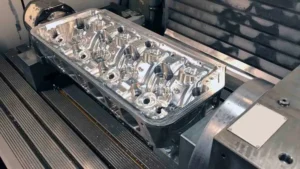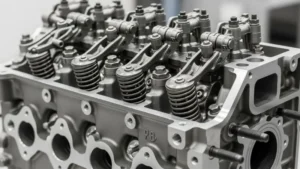
In the high-stakes world of competitive racing and extreme engine tuning, the cylinder head is often the deciding factor between a podium finish and a catastrophic engine failure. While cast cylinder heads have served the automotive industry for over a century, a more robust, precision-engineered alternative has taken center stage in the performance aftermarket: the billet cylinder head.
To understand why professional engine builders are moving away from traditional casting in favor of billet components, one must look at the intersection of material science, fluid dynamics, and modern CNC manufacturing. A billet cylinder head represents the pinnacle of valvetrain stability and airflow efficiency, offering a level of customization and structural integrity that a standard cast part simply cannot match.
The Fundamental Difference: Billet vs. Cast
To define a billet cylinder head, we must first look at how it is born. Most OEM and even many performance cylinder heads are made through a casting process. This involves pouring molten aluminum into a sand or investment mold. While efficient for mass production, casting inherently introduces risks such as porosity (tiny air bubbles trapped in the metal), core shift (where internal passages aren't perfectly aligned), and inconsistent wall thickness.
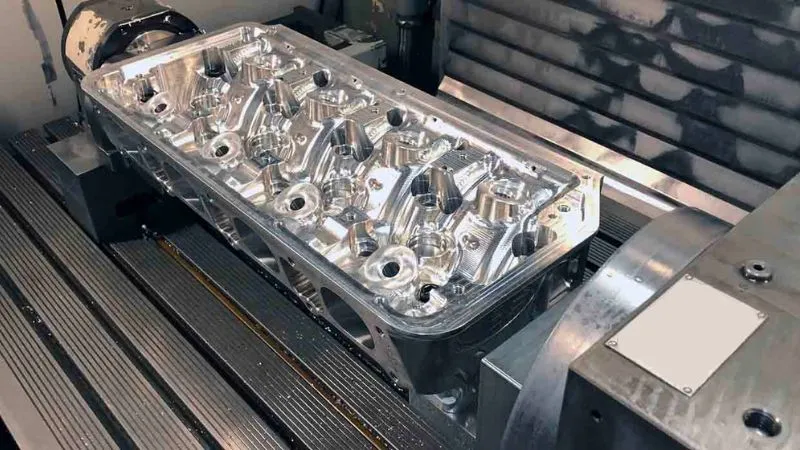
A billet cylinder head, by contrast, is carved entirely from a solid block of high-grade aluminum alloy, typically 6061-T6 or 7075-T6. This process, known as subtractive manufacturing, utilizes multi-axis CNC (Computer Numerical Control) machining to whittle down a 100-pound (or heavier) block of aluminum into a finished, high-performance masterpiece.
Why Material Density Matters
Because a billet head starts as a solid, forged-quality block, the molecular structure of the aluminum is much denser and more uniform than a cast part. In high-boost applications—such as those seen in drag racing or professional drifting—cylinder pressures can reach extreme levels. Under these conditions, cast heads can "flex" or develop micro-cracks. Billet heads remain dimensionally stable, ensuring the head gasket stays sealed and the valvetrain stays in perfect alignment even when subjected to thousands of pounds of force.
The Anatomy of Performance: Why Go Billet?
The primary motivation for choosing a billet cylinder head isn't just strength; it is the freedom of design. When you are no longer restricted by the limitations of a mold, the possibilities for engine architecture expand significantly.
1. Optimized Port Geometry
In a cast head, the intake and exhaust ports are limited by the ability to pull a core out of a mold. This often results in compromises in port angle and volume. With CNC machining, engineers can program complex, high-velocity port shapes that would be impossible to cast. This leads to superior volumetric efficiency, allowing the engine to breathe better at high RPMs.
2. Custom Combustion Chamber Designs
Billet manufacturing allows for the creation of bespoke combustion chamber shapes. Engine builders can adjust the "quench" areas and volume to perfectly match a specific piston dish or dome, optimizing the flame front and reducing the likelihood of detonation. For builds running exotic fuels like M1 methanol or E85, this level of precision is vital for extracting every ounce of horsepower.
3. Superior Cooling Passages
One of the most impressive feats of modern billet engineering is the "water-jacketed" billet head. Using advanced 5-axis machining, manufacturers can drill and mill internal cooling passages that wrap around the combustion chambers and exhaust seats more effectively than cast passages. This leads to more uniform heat dissipation, preventing "hot spots" that can lead to pre-ignition.
Structural Integrity in Extreme Environments
For engines producing 2,000 to 5,000 horsepower, the cylinder head acts as a structural member of the engine. In these environments, the "clamping force" required to keep the head attached to the block is immense.
Resistance to Deck Deflection
The "deck" is the flat surface of the cylinder head that meets the engine block. Under high boost, a cast deck can actually bow or lift slightly, causing a blown head gasket. Billet heads usually feature a much thicker deck surface. Because the material is stronger (higher tensile strength), it resists this deflection, allowing for much higher cylinder pressures without the risk of lifting the head.
Valvetrain Stability
At 10,000 RPM, the valves are opening and closing dozens of times per second. Any flex in the cylinder head can cause the valve seats to move or the camshaft bore to lose its perfect concentricity. Billet heads provide a rigid platform for the valvetrain, ensuring that valve timing remains accurate and reducing wear on expensive components like titanium valves and beryllium copper seats.
The Manufacturing Process: From Block to Beauty
Creating a billet cylinder head is a labor-intensive process that requires both elite engineering software and high-end machinery. It generally follows these stages:
- Digital Modeling (CAD): The process begins in a virtual environment. Engineers design the head in 3D, simulating airflow and stress points.
- Toolpath Programming (CAM): Once the design is finalized, it is converted into thousands of lines of code that tell the CNC machine exactly where to move.
- Roughing: A large CNC mill removes the majority of the material from the aluminum block.
- Finishing: High-speed spindles and specialized bits perform the delicate work of carving the ports, chambers, and cooling passages to tolerances measured in microns.
- Heat Treatment: Often, the head undergoes additional heat treatment to ensure the aluminum reaches the desired hardness and stability.
Weight Savings and Aesthetics
While performance is the main driver, the secondary benefits of billet heads are hard to ignore.
Weight Reduction: Even though the material is denser, the precision of CNC machining allows engineers to remove material from non-structural areas. This can result in a cylinder head that is lighter than its cast counterpart while being significantly stronger. In racing, every pound saved off the front of the car improves weight distribution and handling.
The "Jewelry" of the Engine Bay: There is no denying the visual appeal of a billet component. The distinct machining marks and the bright finish of high-grade aluminum make a billet head the center of attention. For show-quality builds or high-end restorations, the "billet look" signifies a level of investment and attention to detail that is unmatched.
Is a Billet Cylinder Head Right for You?
Despite the clear advantages, billet heads are not a universal solution for every driver. They are a specialized tool designed for specific applications.
The Professional Racer
For Top Fuel, Pro Mod, or high-level Time Attack teams, billet is the standard. When an engine rebuild happens after every few passes, the durability and repeatability of billet components are essential.
The Ultra-High Boost Enthusiast
If you are building a "street" car intended to push 40+ PSI of boost through a 2JZ, RB26, or LS-based platform, a billet head provides the peace of mind that your investment is protected against deck lift and cracking.
The Custom Engine Builder
If you are designing a one-off engine or reviving an obscure vintage motor where cast heads are no longer available, billet manufacturing allows you to "print" a new head from scratch without needing to create expensive casting molds.
Maintenance and Longevity
One common misconception is that billet heads are "fragile" because they are race parts. In reality, their superior material properties often make them more durable than cast heads in the long run. However, they do require professional care.
Because the tolerances are so tight, any machining work (such as a valve job or surfacing the deck) should only be performed by a machine shop familiar with billet aluminum. Additionally, because billet alloys can have different thermal expansion rates than cast iron blocks, using the correct head studs and gaskets is critical to maintaining a long-term seal.
Conclusion
The transition from cast to billet represents the evolution of automotive engineering. By leveraging the power of CNC technology and high-strength aluminum alloys, billet cylinder heads solve the structural and aerodynamic limitations that have hindered high-performance engines for decades. Whether it is the quest for 3,000 horsepower or the need for a perfectly optimized cooling system, billet technology delivers the reliability and power modern racers demand.