Finding a hole in your engine block is often described as the “death knell” for a vehicle. Whether it was caused by a thrown connecting rod, catastrophic overheating, or severe freezing of the coolant, the sight of internal engine components peering through a jagged opening in the crankcase is enough to make any car owner or fleet manager despair.
However, in the modern automotive world, the question isn’t just “can it be fixed?” but rather “is it worth fixing?” This guide explores the technical possibilities of engine block repair, the specialized methods used to patch catastrophic damage, and the economic reality of rebuilding versus choosing a high-quality replacement from a professional factory.
How Does a Hole Get There?
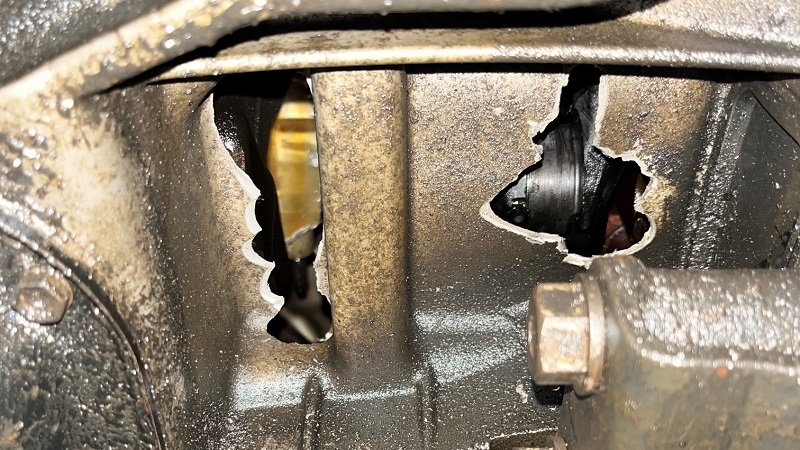
Before discussing the intricacies of engine block repair, we must perform a forensic analysis of the failure. A hole doesn’t just “appear”; it is the result of immense kinetic energy or thermal pressure overcoming the tensile strength of the cast iron or aluminum alloy. Understanding the “how” is critical because it dictates whether the surrounding metal has been compromised by latent stress fractures that aren’t visible to the naked eye.
The "Thrown Rod" Phenomenon: Kinetic Destruction
The most common cause of a hole in the block is a failed connecting rod, colloquially known as “throwing a rod.” In high-mileage engines or those suffering from oil starvation, the rod bearings may seize. When the bearing welds itself to the crankshaft, the rod snaps under the immense torque. Because the crankshaft continues to spin at thousands of RPMs, the broken end of the rod acts like a steel flail, swinging wildly and punching through the side of the crankcase. This often results in a jagged, irregular hole that might also damage the oil pan and internal oil galleries. The impact usually sends metal shrapnel throughout the engine, meaning a “hole in the block” is rarely the only problem.
Hydrolock and Mechanical Displacement
Hydrolock occurs when an incompressible liquid—usually water or excessive fuel—enters the combustion chamber. As the piston moves upward on the compression stroke, it hits the liquid. Since the liquid cannot compress, the force must go somewhere. Usually, the connecting rod bends first, but in high-compression or turbocharged engines, the pressure is so extreme that the piston or rod is forced through the side of the cylinder wall or the outer block casting. This creates a massive breach in the block’s structural integrity, often accompanied by a cracked cylinder head.
Thermal Expansion and Freeze Cracks
In colder climates, if the engine’s coolant mixture lacks sufficient antifreeze, the water inside the cooling jackets will expand as it freezes. Cast iron, while strong, is brittle and has very little “give.” The expansion force of ice is powerful enough to split the block from the inside out. These “freeze cracks” often appear as long, horizontal fissures but can sometimes result in “popped” sections of the block wall that look like holes. Unlike a thrown rod, this damage is purely structural and thermal, but it often renders the cooling system impossible to pressurize.
Bolt Failure and Foreign Object Damage
Occasionally, a rod bolt will stretch and snap due to “fatigue life” being exceeded. Alternatively, if a valve drops into the cylinder and the piston strikes it, the shockwave can shatter the cylinder liner and punch through into the water jacket. Each of these scenarios creates a different type of “hole,” and the repairability depends entirely on how much of the surrounding “casting” remains stable. If the hole is in a “webbed” area of the block designed for reinforcement, the block is almost certainly scrap.
The Technical Methods of Engine Block Repair
When a technician evaluates a “holey” block, they typically look at three primary repair paths. It is important to note that engine block repair on a structural level is an art form as much as a science, requiring specialized equipment that most general repair shops do not possess.
1. Metal Stitching (Cold Casting Repair)
For cast iron blocks, welding is often avoided because the high carbon content in the iron makes it prone to cracking when heat is applied. Metal stitching involves drilling a series of holes across the crack or around the hole and inserting specialized “keys.” These keys are made of a specific alloy that pulls the two sides of the metal together, creating a mechanical seal that is often stronger than the original casting. This is the preferred method for vintage or rare engines where a replacement block is not available.
2. TIG Welding (For Aluminum Blocks)
Modern aluminum blocks are more conducive to welding, but the process is grueling. The entire block must be stripped and pre-heated in an industrial oven to prevent warping. A skilled welder then uses TIG (Tungsten Inert Gas) to fill the hole with compatible aluminum filler rod. After welding, the block must be re-machined because the heat inevitably distorts the perfectly flat surfaces required for head gaskets. This distortion, if not corrected, will lead to immediate head gasket failure.
3. Sleeving the Cylinder
If the hole has punctured the cylinder wall itself, a “sleeve” or “liner” must be press-fitted. This involves boring out the damaged cylinder to a much larger diameter and sliding in a new steel sleeve. This is a common practice in engine block repair, but it requires high-precision machinery. If the hole in the outer block wall is too large, the sleeve will lack the necessary lateral support to stay perfectly round under the intense pressure of combustion, leading to piston ring failure.
Signs Your Engine Block is Beyond Repair
Not every block can be saved. In many professional factories and machining shops, a “red tag” is issued to blocks that exhibit certain terminal symptoms. Knowing these signs can save you thousands of dollars in wasted labor and parts.
Cracks Extending to Main Bearing Saddles
The “bottom end” of the engine holds the crankshaft in place via main bearing saddles. If the hole in the block has spider-webbed cracks that reach these saddles, the block is effectively dead. The main bearings must be perfectly aligned to within microns; any structural compromise in this area will lead to a snapped crankshaft or seized bearings within hours of the first start. Repairing a main bearing saddle is rarely successful outside of high-end industrial or maritime engine shops.
Compromised Oil Galleries or Coolant Passages
The engine block is a labyrinth of veins carrying high-pressure oil and coolant. If a hole is located in an area where these two systems meet, or if an internal oil gallery is shattered, the risk of “intermix” (oil and water mixing) is extremely high. Even the best welding or stitching often fails to seal these internal pressurized channels permanently. A “repaired” block that leaks oil into the coolant is a ticking time bomb for another catastrophic failure.
Structural Integrity and "Hard Point" Damage
If the hole is located at a “hard point”—such as a motor mount boss, a transmission bellhousing bolt hole, or the deck surface where the cylinder head attaches—the block’s ability to hold the weight of the drivetrain or maintain compression is gone. You might be able to patch the hole for aesthetics, but the block may snap or leak under the torque of the engine when the vehicle is under load.
Excessive Distortion (The "Banana" Effect)
When a catastrophic failure like a thrown rod occurs, the sheer heat and physical shock can “tweak” the entire casting. If a machinist puts the block on a flat plate and finds that the main bore is no longer straight or the deck is twisted beyond 0.003 inches, the amount of machining required to fix it would thin the metal to dangerous levels. In this case, the block is no longer a candidate for engine block repair.
Repair vs. Replace
When you are faced with a hole in the engine block, the decision-making process at the “financial crossroad” is critical. While the technical possibility of engine block repair exists, the economic feasibility is a different story. To make an informed choice, you must calculate the “Total Cost of Restoration.” This includes not only the specialized welding or stitching fees but also the extensive machine shop labor required to bring a distorted casting back to usable tolerances.
For many trade operators and vehicle owners, the “Hidden Costs” of repair—such as the risk of a weld failing under thermal stress or the extended downtime while waiting for custom machining—often outweigh the initial savings. In contrast, a factory-fresh replacement provides a clean slate, ensuring that every oil gallery is clear and every structural rib is intact. The following table summarizes the key differences to help you determine the best path for your specific situation:
| Feature | Repairing the Damaged Block | Replacing with a New Block/Engine |
|---|---|---|
|
Initial Part Cost |
Lower (payment is for labor/supplies). |
Higher upfront investment for the unit. |
|
Labor Intensity |
Extremely high (Disassembly + Precision Repair). |
Moderate (Standard engine swap). |
|
Long-term Reliability |
Uncertain; subject to “Heat-Affected Zones.” |
High; uniform metallurgical integrity. |
|
Precision & Alignment |
Requires extensive re-machining. |
Guaranteed factory-spec tolerances. |
|
Warranty Coverage |
Usually “as-is” or very limited. |
Comprehensive factory warranty. |
|
Downtime |
Weeks (waiting for specialist repair). |
Days (standard shipping and installation). |
Conclusion
In conclusion, while a hole in the engine block does not always mean the end of the road, it does require a realistic assessment of engineering limits and financial common sense. Engine block repair is a remarkable feat of craftsmanship, but it is often a race against diminishing returns. If the damage involves the main bearing saddles, critical oil galleries, or extensive structural warping, the most professional and cost-effective solution is to move forward with a high-quality replacement. By choosing a factory-new component, you eliminate the “what-ifs” of a patched repair and ensure the long-term viability of your vehicle or fleet.
XINJIN AUTO PARTS is a professional factory providing high-quality engine solutions and competitive pricing for global customers. If you need reliable replacement parts or expert advice, please Contact Us anytime.