In the world of automotive repair and parts sourcing, a simple seven-to-ten digit sequence holds more power than a VIN: the Original Equipment (OE) Part Number. For mechanics, restorers, and engine builders worldwide, the OE number is the single, undisputed source of truth—the key to unlocking perfect fitment and ensuring the part you order is the one that was designed to be there.
If your business involves complex, high-value components like complete engines, cylinder heads, or turbochargers, relying on anything less than the OE number is a recipe for expensive errors. But finding that elusive code can feel like searching for hidden treasure.
This comprehensive guide breaks down the methods, tools, and best practices for accurately identifying the OE part number for any component, transforming a frustrating search into a simple, reliable process.
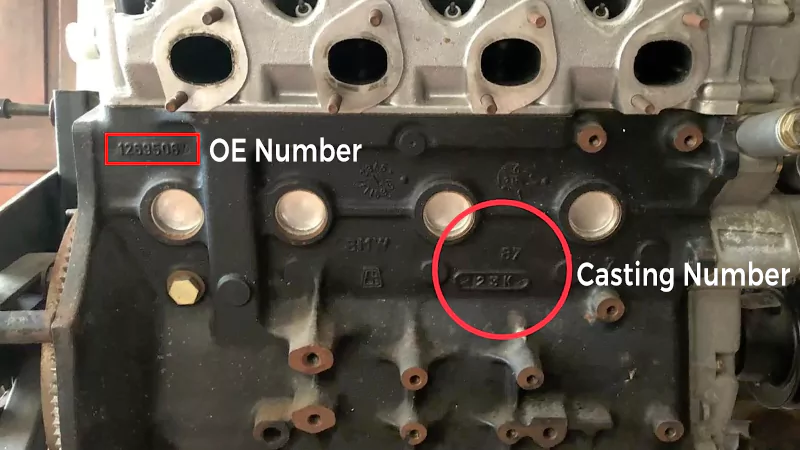
The most reliable way to find the OE number is to read it directly off the original part itself. This is particularly effective for major castings like blocks and cylinder heads.
Cylinder heads are typically cast from aluminum or iron, and the OE number is usually integrated into the mold, appearing as raised numerals. This is often referred to as the Casting Number.
Be cautious. The long sequence of numbers you see often includes foundry codes, revision dates, and material stamps. The true OE Part Number is usually the longest, most coherent sequence (e.g., eight or nine digits) or is explicitly prefixed with the manufacturer’s internal designation (e.g., the letter ‘E’ or ‘F’ on certain Ford heads, or a ‘555’ series on modern GM heads). Take clear photographs of all visible numbers.
Engine blocks often carry the OE number in the casting near the transmission bellhousing or the oil filter adapter. For complete engines, the number may be found on a metal tag riveted to the block, often near the front timing cover or on the valve cover.
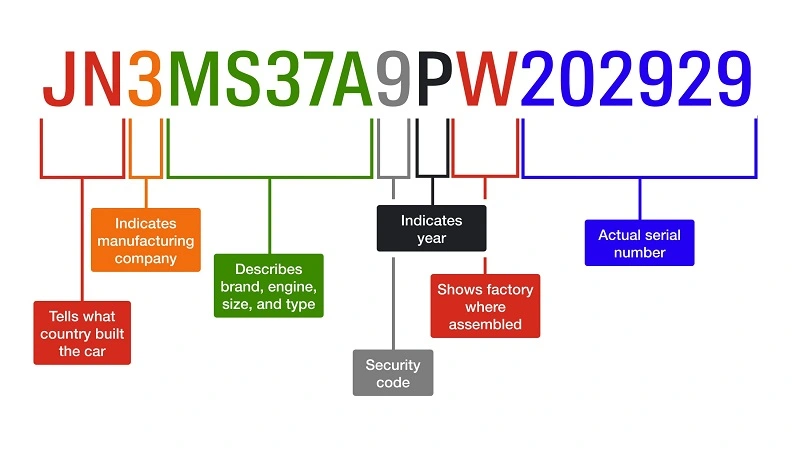
If the part is still in the vehicle, is too difficult to remove, or the number is obscured by grime, the next best option is to use digital resources. This requires precise knowledge of the Vehicle Identification Number (VIN).
The VIN is the key to unlocking the exact factory specification of the vehicle. It reveals the engine code, transmission type, trim level, and—most importantly for the engine—any mid-year production changes that may have affected the part number.
For parts that have extensive interchangeability across various models (like many GM Ecotec or Toyota UZ-series components), knowing the engine family code can often get you close to the OE number.
The engine code (e.g., ‘2AR-FE’ for Toyota, or ‘B4204T19’ for Volvo/Geely) is the manufacturer’s internal designation for the engine family. This code is often found on the vehicle emissions sticker under the hood or encoded within the 8th digit of the VIN.
Once you have the engine code, you can search for technical documents that detail its lineage. For instance, knowing you need a head for a GM F16D3 engine significantly narrows the search, as that engine code dictates key parameters like VVT configuration and cooling channel design. This is especially helpful when dealing with global platforms where a “Chevrolet” part in North America is an “Opel” part in Europe.
Searching for OE numbers is prone to several common errors that lead to ordering the wrong component.
The casting number is the code stamped into the metal at the foundry. The OE Part Number is the code used by the manufacturer’s parts department. These numbers are often similar, but the official Part Number may have suffixes, prefixes, or revisions that are critical for modern components (especially those involving sensors or VVT solenoids). Always try to confirm the Part Number, not just the Casting Number.
Manufacturers often issue revisions (e.g., 12623548 becomes 12623548-A) to fix a design flaw (such as correcting a poor valve guide material or thickening a weak aluminum section). A replacement part must meet or exceed the latest revision. A reputable supplier will always ask for your VIN to confirm you don’t receive an older, known-to-fail version.
This is a critical error for many modern four-cylinder engines. The cylinder heads for a naturally aspirated (N/A) engine and its turbocharged counterpart, even if they share displacement, are often entirely different. The turbo head will have hardened valves, integrated exhaust manifolds, and different cooling channels. Always specify N/A or Turbo in your search.
When all digital methods fail, the local dealership parts counter remains an invaluable, often underutilized resource. Simply providing them with the VIN and the description of the part (e.g., “cylinder head assembly for a 2015 Cruze 1.4L Turbo”) often prompts them to give you the official OE part number, which you can then use to source the part from your preferred supplier.
For any high-value repair involving engines or cylinder heads, accuracy is paramount. Taking the time to definitively identify the OE part number is the single best investment you can make. It saves time, prevents costly shipping errors, and ensures that the repaired engine operates as reliably as the day it left the factory.
Sourcing these precise, quality-controlled components requires a supply chain that understands OE specifications and casting requirements at a fundamental level.
At XJXPARTS, we are a factory specializing in the manufacturing of cylinder heads, complete engines, and associated components for a vast range of vehicle makes and models. Our process is built around meeting and exceeding OE standards, ensuring that when you provide us with a Part Number, the part you receive is engineered for perfect fitment and long-term durability. We control the process from raw material to final machining, giving you the best quality assurance available.
If you have your OE number and are ready to source a new component, or if you need expert assistance in identifying the correct part for a complex project, our technical team is ready to help.