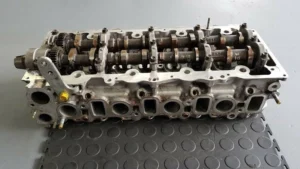
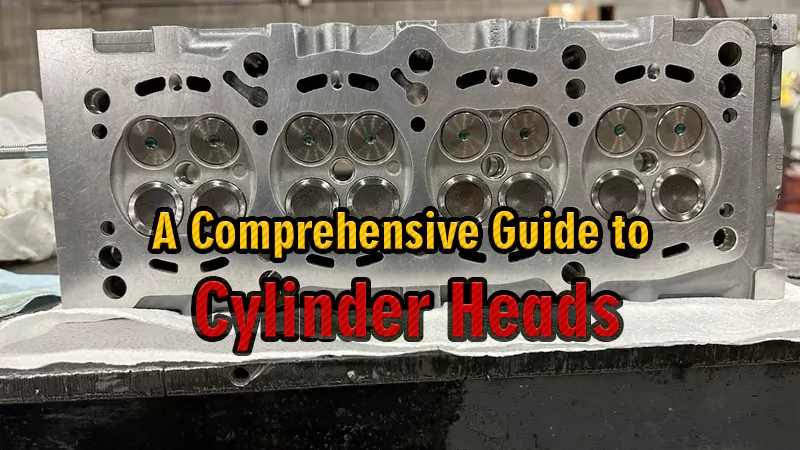
The cylinder head is one of the most important parts of your engine. As its name suggests, it sits on top of the engine block. Inline engines have a single cylinder head, while V-shaped or boxer engines have two—one for each bank of cylinders. Cylinder heads are usually made of cast iron or aluminum, and they house many key components that make your engine run, such as intake and exhaust valves, rocker arms, and spark plugs. In overhead cam (OHC) engines, the camshafts are also located inside the cylinder head.
The cylinder head is more than just a cover—it is where much of the engine’s action takes place. It contains the combustion chambers, which is where the fuel-air mixture ignites and drives the pistons. For this process to happen efficiently, the cylinder head connects to the intake and exhaust manifolds.
Air and fuel enter the engine through the intake manifold, pass through the intake valves, and enter the combustion chambers. When combustion occurs, the exhaust gases exit through the exhaust valves and ports to the exhaust manifold.
The intake and exhaust valves are controlled by the valvetrain, which ensures they open and close at precisely the right time. Depending on the engine design, the valvetrain may include rocker arms, push rods, lifters, and one or more camshafts. Some engines have the camshaft in the engine block (cam-in-block), while others place it directly above the valves (overhead cam), allowing it to operate the valves directly.
Flathead Engines
Early engines used flathead or sidevalve designs, where the valves were located on the side of the cylinder block. Fuel and air entered from one side, and exhaust exited the same side. These engines were simple, reliable, and easy to repair—even a broken valve didn’t stop them from running.
However, flathead engines had limitations. Exhaust gases followed a long, indirect path, which reduced performance and caused overheating. Later designs, like T-head engines, improved gas flow by placing intake and exhaust on opposite sides. While sidevalve designs are mostly obsolete for cars, they are still used in farm machinery and simple engines.
Modern Cylinder Head Designs
Intake-Over-Exhaust Engines
The intake-over-exhaust (IOE) configuration was an important transitional step in engine design, bridging early sidevalve engines and modern overhead valve systems. In this layout, the intake valve is moved to the cylinder head, while the exhaust valve remains in the engine block.
Air and fuel enter through the intake valve in the head, while exhaust gases leave through the valve in the block. This design improves airflow compared to sidevalve engines, allowing more efficient combustion. Early versions relied on suction to operate the intake valve, but later models adopted mechanical valvetrains using push rods and rocker arms for more reliable valve actuation.
Advantages:
- Better breathing than flathead engines.
- Simple design with fewer parts than fully OHV engines.
- Still mechanically robust and easier to maintain than OHC engines.
Disadvantages:
- The exhaust valve in the block still restricts airflow and limits high-speed performance.
- Complexity increased compared to flathead engines.
Applications:
- Early motorcycles and some small displacement engines.
- Rarely used in modern vehicles but historically significant as a stepping stone to OHV designs.
Overhead Valve (OHV) Engines
OHV engines, also known as cam-in-block engines, advanced the IOE concept by placing both intake and exhaust valves in the cylinder head. The camshaft remains in the block and operates the valves via push rods and rocker arms.
How it works:
- The crankshaft drives the camshaft in the engine block.
- Push rods transfer motion to rocker arms in the head, opening and closing the valves.
- This allows both intake and exhaust to flow directly into and out of the cylinder, improving efficiency over IOE engines.
Advantages:
- Compact engine design, saving space.
- Mechanically simple and robust; highly reliable over long service intervals.
- Still used in some high-torque applications, such as V8 engines in trucks and classic American cars.
Disadvantages:
- Push rods add valvetrain inertia, limiting high-rev performance.
- More moving parts increase noise and maintenance points compared to OHC engines.
Applications:
- Many classic American V8s, including Chevrolet small-block engines.
- Off-road and heavy-duty engines where torque and durability are prioritized over high RPM performance.
Overhead Camshaft (OHC) Engines
OHC engines represent the modern standard for most passenger vehicles. Here, the camshaft is moved above the valves, directly actuating them and eliminating the need for push rods.
How it works:
- The camshaft is connected to the crankshaft via a timing chain, belt, or gears.
- Single overhead camshaft (SOHC) engines use one camshaft to control both intake and exhaust valves.
- Dual overhead camshaft (DOHC) engines use separate camshafts for intake and exhaust valves, allowing more precise valve timing and often enabling multiple valves per cylinder.
Advantages:
- Reduced valvetrain inertia allows higher engine speeds (RPMs) and smoother operation.
- Greater flexibility in valve placement and combustion chamber design.
- Multiple valves per cylinder improve airflow, efficiency, and power.
Disadvantages:
- Larger and more complex than OHV engines, increasing manufacturing costs.
- More components can mean higher repair costs if problems occur.
Applications:
- Most modern passenger cars use OHC or DOHC designs.
- High-performance engines, including sports cars and motorcycles, often use DOHC configurations to maximize power and efficiency.
Combustion Chamber Shapes
Hemispherical Chambers
Hemispherical, or HEMI, chambers are characterized by valves placed at opposing angles, creating a crossflow path for air and fuel. This design improves airflow, allows more complete combustion, and supports higher compression ratios, resulting in greater engine power. Hemispherical chambers are also relatively straightforward to manufacture, which contributed to their popularity in performance engines, including Chrysler’s iconic HEMI series.
Pent-Roof Chambers
Pent-roof chambers flatten the top of the combustion chamber into a roof-like shape, allowing more valves per cylinder, typically four. This improves airflow during both intake and exhaust strokes and enhances combustion efficiency. Pent-roof designs are now the most common in modern engines, balancing high-speed performance with fuel efficiency and emissions control.
Wedge-Shaped Chambers
Wedge-shaped chambers position the valves at angles to compress the air-fuel mixture efficiently toward the spark plug. This focused combustion generates strong power relative to chamber volume. Wedge designs are often used in engines where compactness, high torque, and reliability are desired, and they are still popular in some performance and racing engines.
Bathtub-Shaped Chambers
Bathtub-shaped chambers feature an oval, inverted design with a short flame path. The spark plug is mounted to the side, and the valves are positioned straight into the top of the chamber. This simple layout allows for a straightforward valvetrain and rapid combustion, making it suitable for cam-in-block engines where simplicity and reliability are prioritized over high-RPM airflow.
Cylinder Head Materials
Cylinder heads are usually made from cast iron or aluminum.
- Cast iron: Strong, inexpensive, but heavier.
- Aluminum: Lightweight, better heat dissipation, reduces overheating risk.
Some engines combine an aluminum head with a cast iron block. This can cause problems because the metals expand at different rates, which may lead to warping or cracking.
Conclusion
Understanding cylinder heads is essential not only for engineers and enthusiasts but also for anyone looking to optimize engine performance and reliability. From classic flathead designs to modern dual overhead cam engines, the cylinder head remains a critical component influencing power, efficiency, and durability.
If you are looking for high-quality cylinder heads or custom solutions for your engines, our factory specializes in manufacturing durable and precision-engineered cylinder heads for a wide range of applications. Contact us today to discuss your requirements and discover how we can provide reliable components tailored to your needs.